News
Abdulsalami Recalls How Abacha Involved Him In The Coup

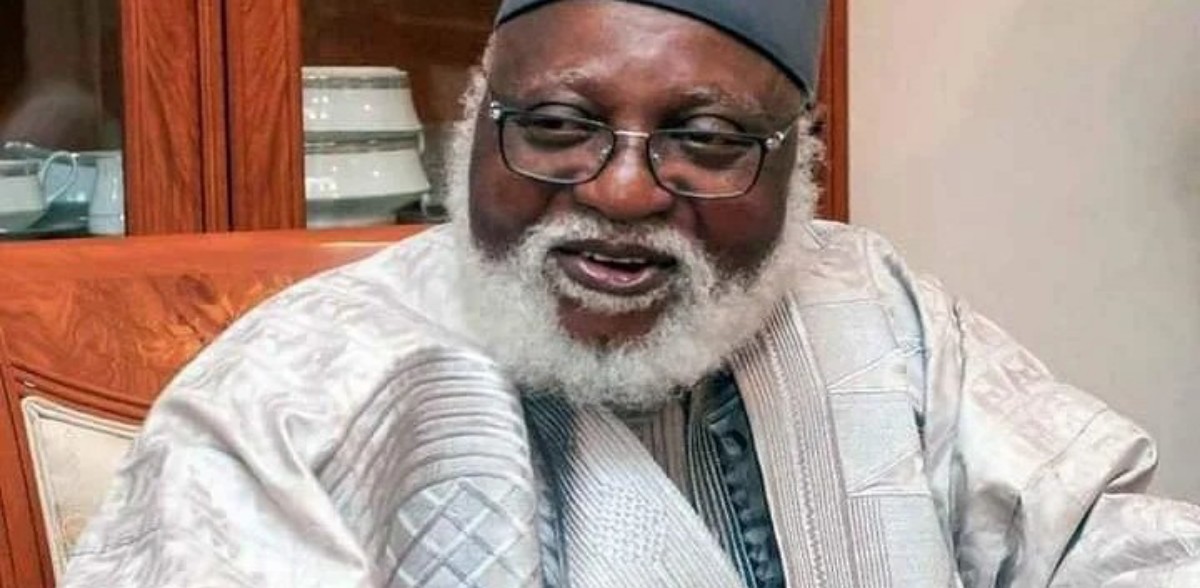
Gen. Abdulsalami Abubakar (retd.), a former head of state, has disclosed that during the coup in November 1993, General Sani Abacha personally called him and coerced him into accepting the position of Chief of Army Staff.
He revealed that after the coup that overthrew the Interim National Government, Abacha offered him the position of Chief of Army Staff twice. He insisted to Abacha that he did not want to be a tool in the hands of civilians who wanted to use the military.
Chapter 17 of Abubakar’s 264-page, 27-chapter autobiography, “Call of Duty,” which our correspondent was able to obtain during the book’s public presentation at the Aso Rock Villa in Abuja, contains the revelation.
The event, held on Saturday to mark the former Head of State’s 84th birthday, was attended by President Bola Tinubu, who was represented by Vice President Kashim Shettima as Special Guest of Honour.
He wrote;
“He asked if I was aware that Abacha and Gusau had travelled to Abuja. I was surprised and asked why they should travel to Abuja, because Abacha himself asked me to see him the next day.
“He said, ‘These Army guys are thinking of a coup. Let me tell you that the Navy would not be a part of it.’ I immediately told him to count me out, as I was not in the know.
“I was surprised that Abacha knew he would be travelling to Abuja and still asked me to see him on Tuesday. If there was any rumour of a coup, this was the first time I heard it.”
“I replied, ‘Like what?’ He said, ‘You people are trying to remove Chief Ernest Shonekan.’ I said I had no idea, but that he should let me find out. That was the second time I was hearing the rumour.”
“They left and returned one after the other to tell me that my loyalty would be questioned if I did not attend the meeting.
“I replied that it didn’t matter what they thought; since I was not invited, I was not going to attend the meeting.”
“When I got there, the soldier at the gate said there was an instruction not to allow anybody in and that my name was not on the list of attendees. I went home, thoroughly embarrassed,” he recalled.
“He said: ‘Sir, I am giving you orders for the last time.’ I was furious and replied: ‘You are giving me orders for the last time? Who are you? You are foolish!’
“He replied: ‘The Commander-in-Chief wants to see you, and we have decided to make you the Chief of Army Staff.’ I called him by name and insulted him before hanging up the phone.
“Military discipline was being thrown out of the window within the twinkle of an eye!”
“I told him that he and Babangida had roasted me and put me under a difficult situation when they were telling everybody I had been appointed Chief of Army Staff, whereas there was no such thing.
“I then made two requests. One was that I would agree to be his Chief of Army Staff, but I wouldn’t hear my retirement over the radio if and when he found me as a thorn in his flesh. Instead, I should be politely told to go home.”
“Secondly, my relationship with him would never change, as I would always tell him the truth. I said that if he accepted my conditions, I would accept his offer. ‘Okay, thank you.”
“He said: ‘Sir, you will be retired from the Army.’ I was surprised and asked how he knew. He told me that he was there when I visited the Flag Staff House the previous day.
“He said the plan was to make me Chief of Army Staff, but the decision was changed after I left,” the former Head of State wrote.
“I thanked him. I told him that he should not associate with me openly for his own sake because I didn’t want whatever my sins were to be visited on him.
“I pleaded that he should send any message he had for me by proxy.”
“I said we should prepare to go home.”
“She opened her bag, brought out a list, and said it was given to reporters but was embargoed till 4:30 pm. On the list, I saw my name as Chief of Defence Staff. I was shocked and said we were in for a tough job.”
“I was a good footballer. Abacha was a defender, while I was a forward liner, what is called a striker today.
“He always marked me during matches.
“We naturally ended up as friends. That was how our relationship started.”
“I said to him: ‘Sani, if you do not take action, one day, you would be sitting down here and you would hear your name over the radio that you have been removed as the Head of State.”
In reflecting on his experience, Abdulsalami emphasizes the complexity of political upheavals and the personal sacrifices involved. Despite the tumultuous circumstances, he remains committed to Nigeria’s stability and progress.
His account serves as a reminder of the intricate human stories behind significant historical events and the importance of leadership rooted in integrity and dedication to the nation’s welfare.
Related